
Recordings Still Make Magic
And They Hold History

This past summer, I had the immense pleasure of attending a temporary exhibit at the Taipei Music Center 台北流行音樂中心, titled Modern Era: Dawn of Pop Music 摩登時代:唱片轉動 · 流行誕生.
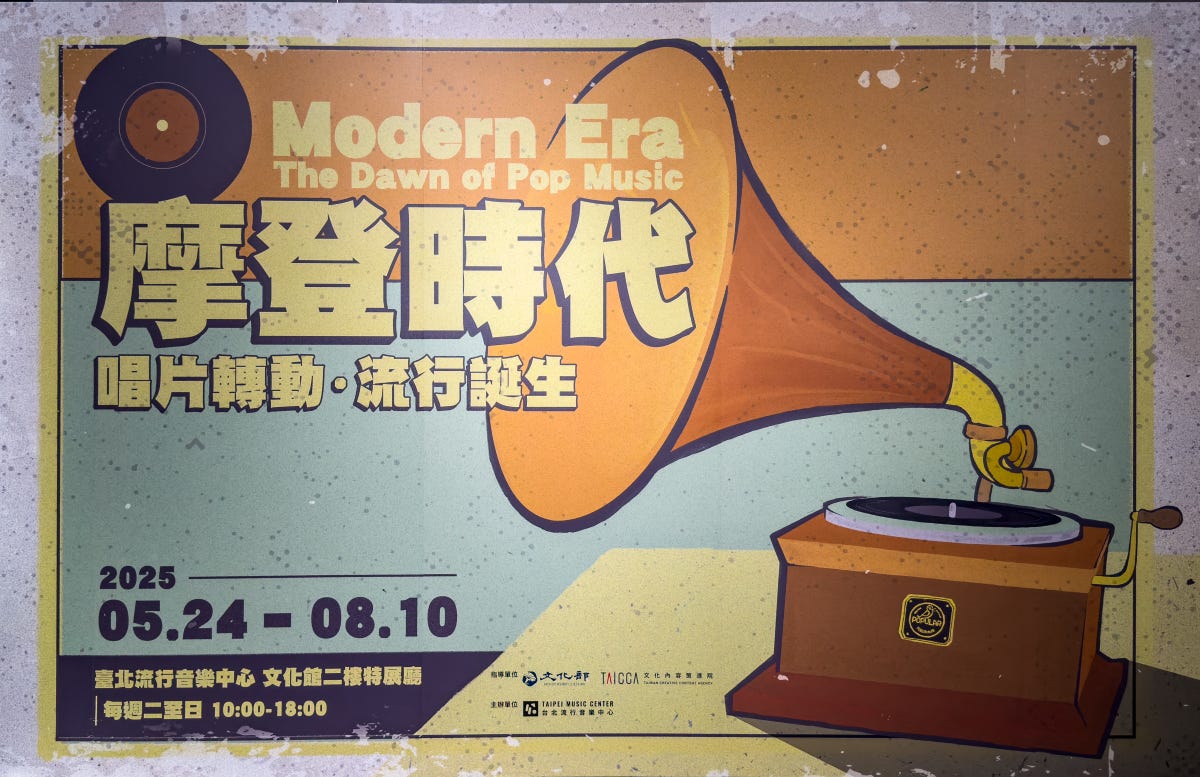
Greatly enriching my experience was the opportunity to attend multiple guided tours led by two of the main contributors to the exhibit. The first was a formal tour led by Lin Tai-wei 林太崴, a musicologist, public intellectual, historic record collector, and author of books like The True Story of Formosa Song 怪音來了:本島第一個大陸因時代 (2023). The second was another tour jointly led by Lin Tai-wei and Lin Pei-ru 林佩如 (no relation), the owner of the local cafe and vinyl afficionado hotspot Sounds Good 聲色. The cafe frequently plays host to listening events, while Lin Pei-ru herself is an avid collector of historic gramophones and other sound systems. Finally, I had the opportunity to experience a third, impromptu tour, occurring when I ran into Lin Pei-ru on a return visit to the exhibit to take photos. As she showed me some additional details about various exhibit items, she gathered a crowd that ultimately turned into a full-blown tour.
Several themes emerged over the course of these three tours. The first theme, most closely related to my research, is a question of history. Namely, it was an excellent demonstration of the ways that recordings not only have a history of their own, but also help to constitute other histories. In this case, recordings help to bring into focus a pre-War history of Taiwan as Taiwan that is too often lost amid narratives of cross-Straits geopolitical tensions. The tale told by these recordings is not simply that of a Japanese colony, or a territory usurped from the Qing, or the disputed “Republic of China.”1 Rather, it is a history that brings into view—and hearing—a modern, vibrant, cosmopolitan Taiwan.
The second theme that emerged was a more global history. From this vantage point, we see how technologies like recording intensified the commercial, technological, and cultural entanglement of far-flung territories that is characteristic of contemporary globalization.
The last takeaway from these tours, however, is the one that most surprised me. Most of the museum workers were not allowed to touch the various albums and players on display—these are fragile antiques, and it requires an experienced hand to handle them safely. However, as the owners of these materials, Tai-wei and Pei-ru were allowed to offer demonstrations, and they did so generously on each of the tours I was fortunate enough to witness. Critically, these demonstrations are where the exhibit transitioned from a historically rich display into a moving demonstration of the enduring magic of recording technology. And this is where I want to begin.
Recordings as Musical Magic
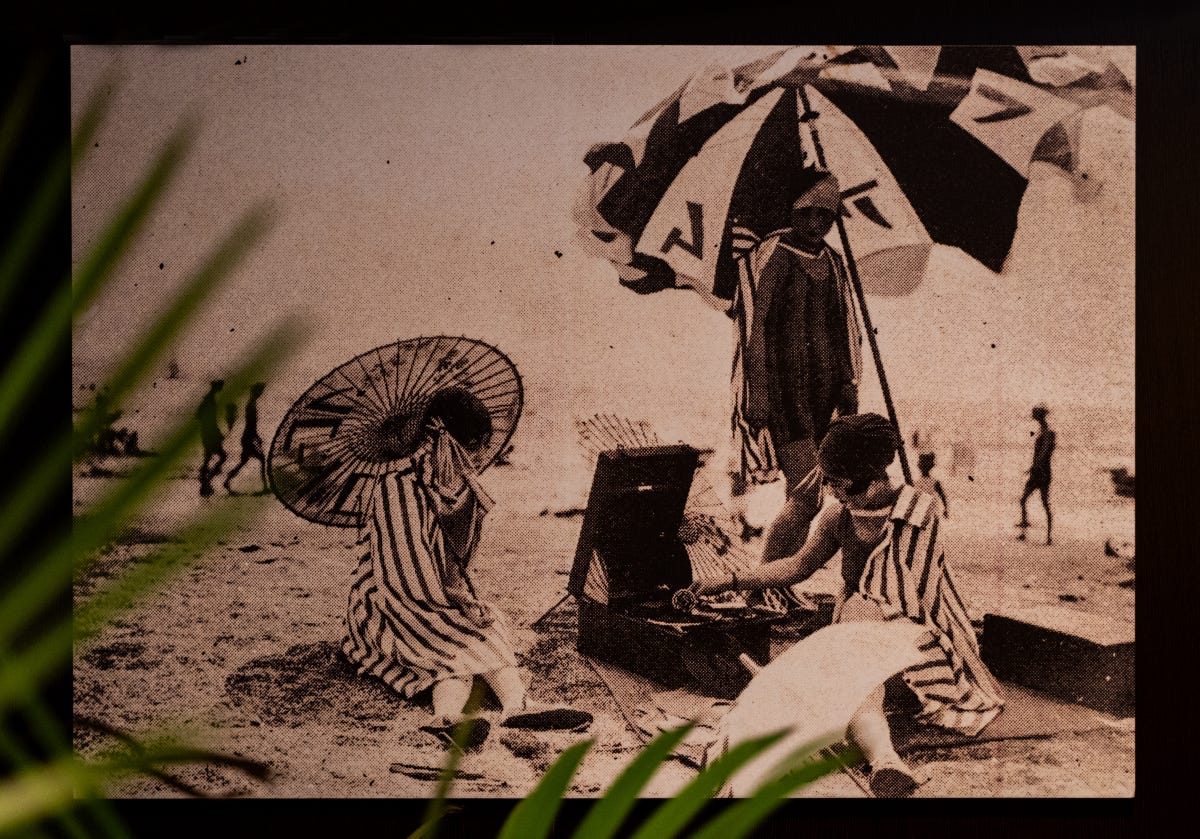
Lin Pei-ru’s collection of early record players is truly fabulous. It spans small, portable devices that “early 20th-century influencers” (her words) could bring to the beach, to solid tabletop devices encased in gleaming rare woods, and topped with a custom-made paper mâché horn large enough to make a sousaphone blush.
In today's world of constant media immersion, it is easy to take for granted the host of technologies that we routinely shove into our ears as a means to listen to the music piped out of another host of technologies housed in our phones. And of course, whatever music issues forth from our phones usually relies on the third host of technologies that sustain the internet of the 21st century.
With this tendency to take for granted can also come a sense of banality. Recording technologies today so often fade into the background. Portable earphones are no longer the tinny-sounding wonders that they were at the beginning of the Walkman era. Speakers, demoted from their previous status of furniture centerpiece, are often valued as much for their discreetness as for their wondrous clarity of sound. And for the vast majority of listeners, recordings are no longer physical objects to handle, examine, collect, preserve, pore over, and treasure. Rather, they arrive on rapidly changing algorithmic tides, before receding just as quickly into the back of our consciousness.
Given these realities, I was particularly surprised during my final tour with Lin Pei-ru. As she played a couple of recordings that I hadn’t yet heard, a small group of people began to gather around the devices on which the records were playing. And the more Pei-ru described these early devices, the more people began to follow along with this impromptu tour. By the end, around 20 people were following Pei-ru through the exhibit as she unveiled ever more devices for listening.
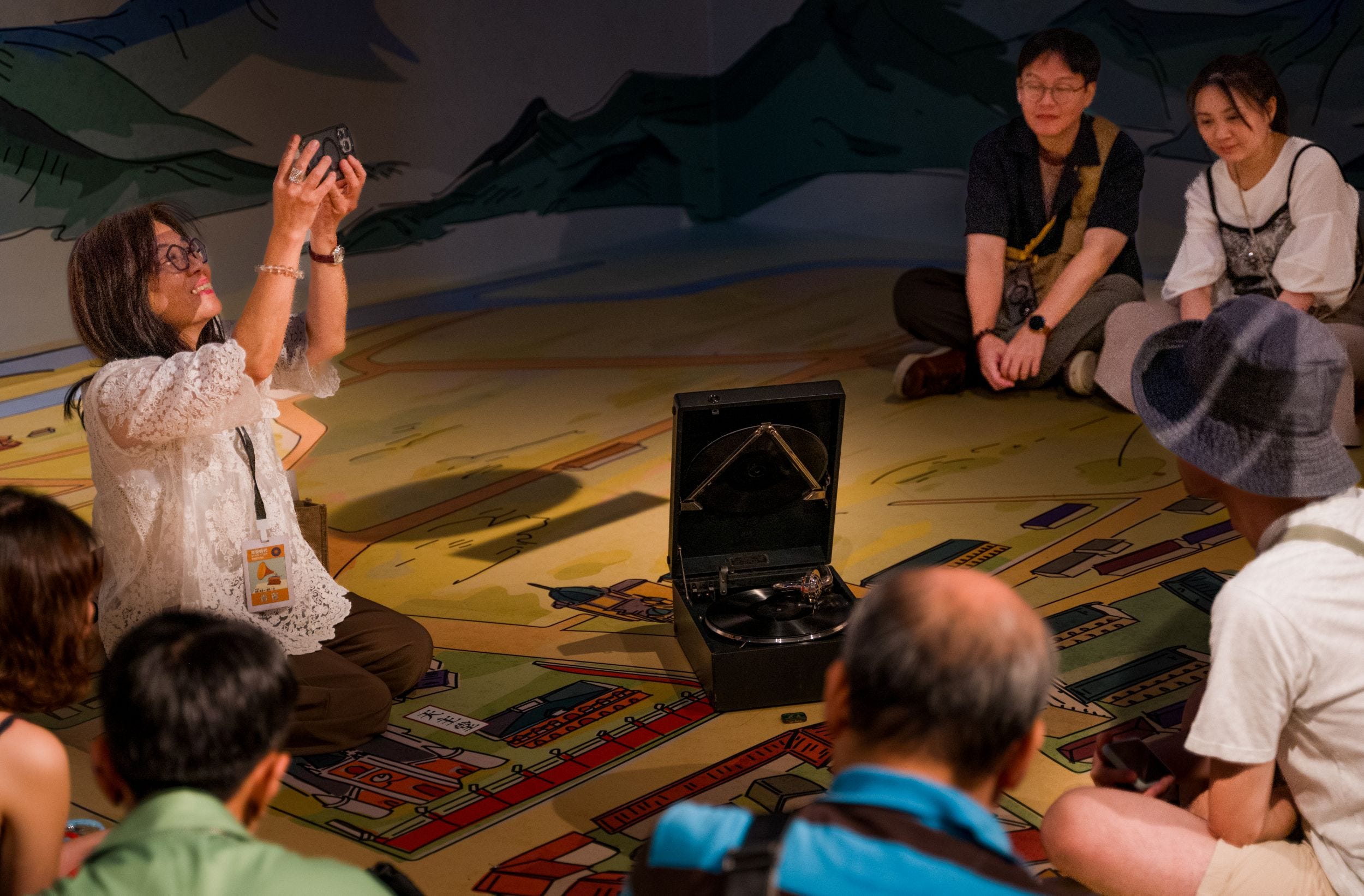
Despite the fact that these machines were produced roughly 100 years ago in a pre-electric era (only one device of roughly a half dozen that she demonstrated uses electricity, and that only to power the turntable), these devices still function perfectly. In fact, many of them produce stunning sound quality, especially when you consider that these sounds are essentially the product of a trombone horn eavesdropping on an intimate moment between a steel needle and some aging shellac.
And yet, every time Lin Pei-ru led us to a new machine, people clustered close. This was not to hear better—many of these systems produce astonishingly loud sounds. Rather, it was to see the magic of these recording devices up close.
This was nowhere clearer than at one of Lin Pei-ru’s final stops, the Lumière, produced in the 1920s by His Master’s Voice, the British branch of the Victor Company. Miraculously, there is no speaker box on this device. Rather, all of the sound emanates from the pleated golden disc that hovers above the spinning record. As you'll see in the video below, the first time I witnessed this device in action, other observers were as eager as I was to capture on camera what seemed like a physical impossibility: a non-electric device playing crystal-clear sound out of a crimped copper plate.
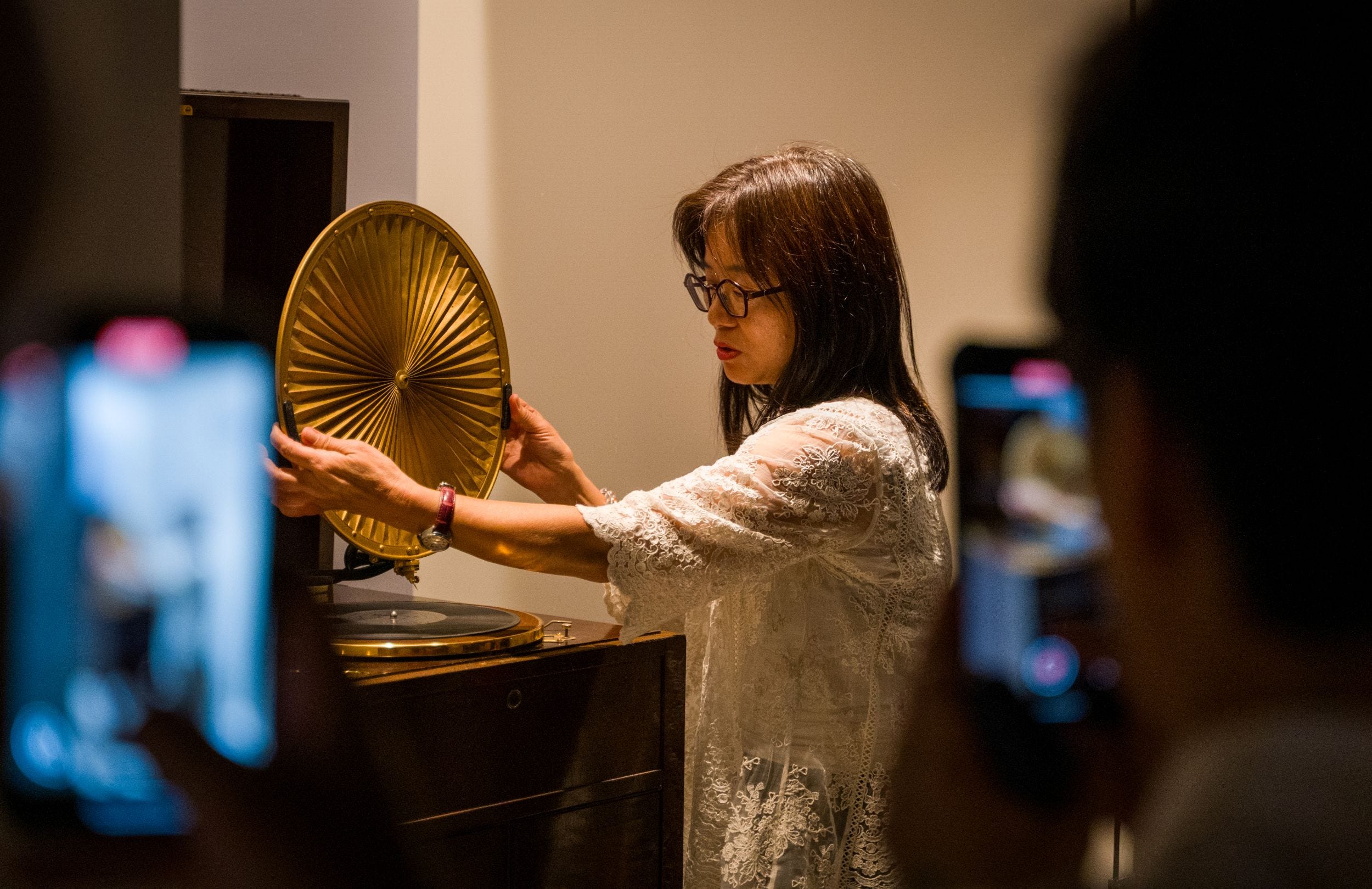
But the wonder this device still inspires a hundred years after its manufacture became even more apparent on Pei-ru’s impromptu tour a few days later. As the device played, she rushed downstairs to grab a final, portable recording device to show her audience. As we listened in Pei-ru’s absence, it suddenly sounded as though Bing Crosby had imbibed a bit too freely before recording the famous number “Quizás, Quizás, Quizás.” The suddenly slowing tempo, slurring lyrics, and uneven pitches were the result of a loss of tension in the spring that powers the device.
At this point, the impromptu tour had been going on for some time. Lin Pei-ru was still absent, rushing to procure one final device (seen above in fig. 4). Given that this entire tour was unplanned, it would have seemed a logical moment for people to disperse, or at least to wander through the rest of the room to see the other items on display. But even as Bing Crosby first sputtered and then fell silent, the crowd did not disperse. Instead, they stood in hushed silence, staring at the magical machine. By the time Lin Pei-ru returned a few minutes later, everyone was still standing and waiting patiently, hoping for the chance to see her crank the spring and bring this wondrous machine back to life.

Thus, the Lumière provided an important reminder: when we turn our attention to recordings and recording devices, rather than allowing these technologies to fade into the background, they still have the power to engender wonder. They still make magic.
Recordings as Global History
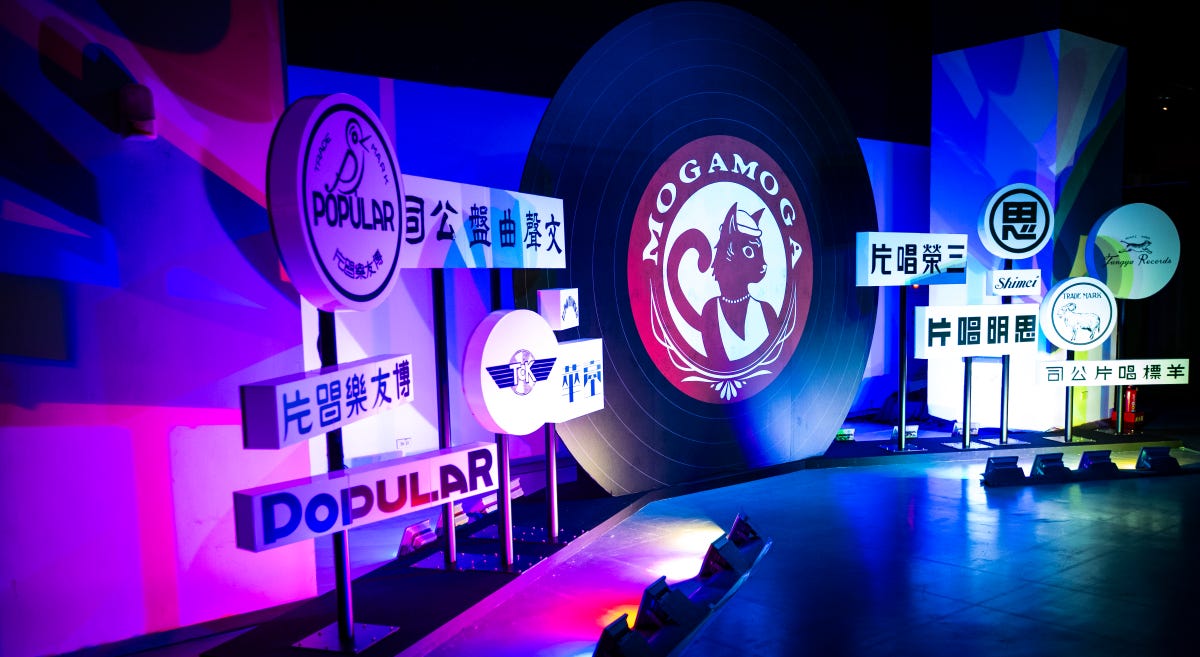
In the tour that was jointly led by Lin Tai-wei and Lin Pei-ru, another issue that emerged was the degree to which the history of the recording industry is a global history. Take, for example, the company that produced the first Taiwanese-language popular music records, Nipponophone. Nipponophone, as the name suggests, was a Japanese recording company. Because the Japanese colonized Taiwan from 1895-1945, it is unsurprising that a Japanese company should be among the first major record companies on the island, the first to produce Taiwanese-language hits, and the first to cultivate its own stable of Taiwanese popular music stars.
But Nipponophone began in Japan as an offshoot of the British label Columbia, itself originally a subsidiary of the American record company of the same name. Thus, the presence of Nipponophone in Taiwan is not a simple tale of a Japanese company entering a colonial market. Rather it is a tale of global technological diffusion, whose rapid spread was fueled in part by the wondrous phenomenon of trapping the ephemeral experience of musical performance on a small round disc, and allowing us for the first time to listen to a single performance—the same performance—over and over again.
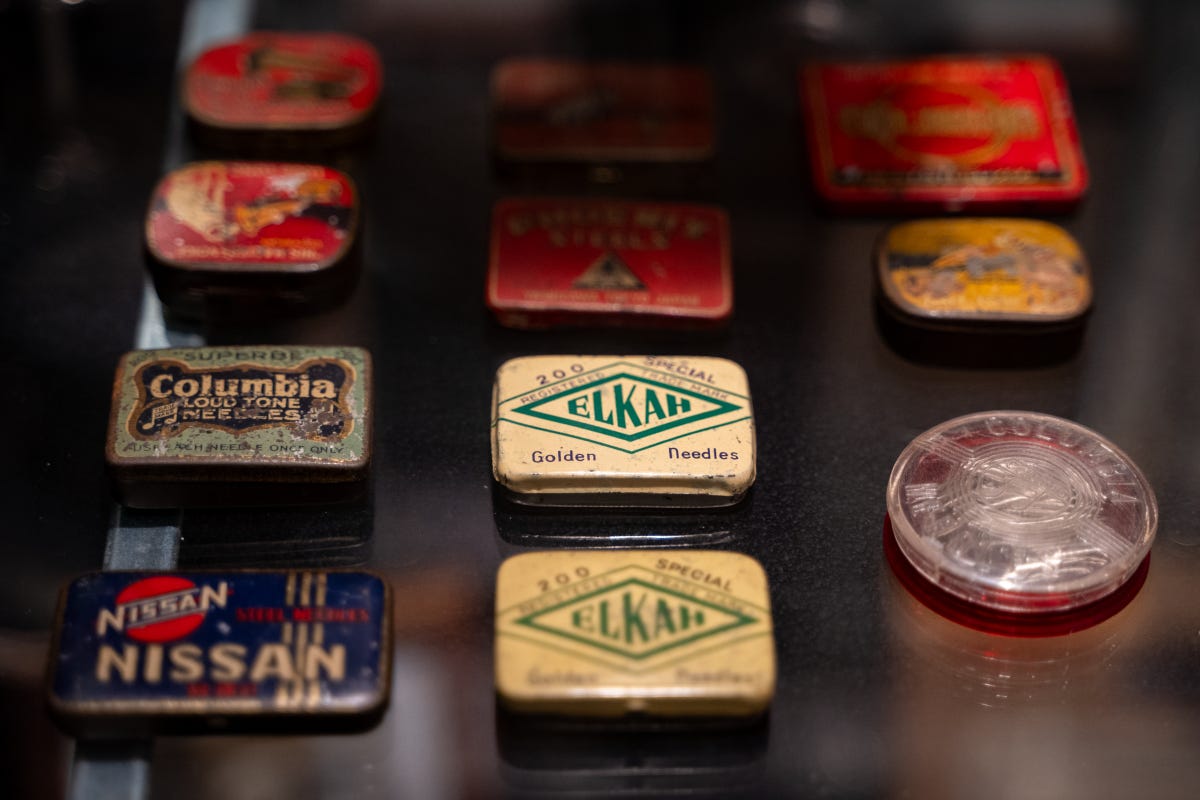
Even the needles used to play the new media of records were a case study in global distribution. Looking into a display case at the exhibit revealed needles from America, Germany, Denmark, “Bohemia,” and several other nations.
It would be a mistake, though, to identify recording technologies as the sole instantiations of the ways that global flows of sound technology changed areas like Taiwan. For example, many early audiophiles in Taiwan went to coffee shops that owned gramophones, where the opportunity to listen to recordings was a significant draw. So important were these coffee shops, the Modern Era exhibition included reconstructions of not just one, but two cafes! (The importance of coffeeshop culture in Japanese-era Taiwan is captured in period dramas like La grande chaumière violette 紫色大稻埕, the series I discussed in one of my earliest Unmusable posts.) Like recording technology itself, however, the coffee shop culture of Taiwan, which arrived on the island via Japan, was itself the product of expanded global trade starting in the 19th century.
Though phenomena like recordings and coffee shops may be the result of colonial encounter, we would be wrong to assume that Taiwanese citizens had no agency in the way that they engaged with these innovations.
Take, for example, the popular musician Sûn-sûn (純純, pronounced Chun-chun in Mandarin). Sûn-sûn (1914-1943) was the most popular musician of her era, hailed in both this exhibit and hit documentaries like Viva Tonal: The Dance Age 跳舞時代 (dir. Chien Wei-ssu 簡偉斯 and Kuo Chen-ti 郭珍弟, 2003) as Taiwan’s first real media celebrity in the modern sense of the word.

For all the heights of popularity Sûn-sûn reached, she started from humble origins, learning stagecraft from her parents, who were part of a Taiwanese opera (koa-á-hì 歌仔戲) troupe. But she used some of her earnings to open up a coffee shop in Taipei, where young, well-to-do intellectuals would gather to be in close proximity to the famous chanteuse, to listen to music, and to sip coffee.
As in the case of Nipponophone, Japanese colonizers may have been immediately responsible for turning coffeeshops into a fixture of urban Taiwan, but the phenomenon of coffee also connected Taiwan to broader global circuits. Underscoring the global network that brought both coffee and popular music to Taiwan, and then turned them into local institutions that generated their own traditions and cultural capital, Sûn-sûn named her coffeeshop Brazil.
Recordings as Taiwanese History
I was very fortunate to have the opportunity to talk at length with one of the organizers of Modern Era: Dawn of Popular Music, Lin Tai-wei. Where Lin Pei-ru commands a detailed history of the record players on display at the exhibit, Lin Tai-wei is a serious scholar and collector of historical recordings (including an advanced degree from the Graduate Institute of Musicology at National Taiwan University).
It was clear from my first meeting with Tai-wei that he has been a collector for decades. When I asked him how he got started, his answer surprised me. He explained that, as a teenager, he was fascinated by historical recordings of Western opera singers, particularly the soprano Amelita Galli-Curci (1882-1963). Galli-Curci was a rough contemporary of other famous sopranos like Luisa Tetrazzini and Nellie Melba, and it is these latter divas who are more widely remembered today. But Tai-wei particularly values Galli-Curci for a vocal production that comes across as easier, more relaxed, and more suited to the pre-Verdian expansion of the orchestras that led to ever larger voices commanding ever greater stage time.
As a young man, Tai-wei had the opportunity to travel to Italy. While there, his knowledge of historical operatic figures consistently wowed the older generation of Italians. But Tai-wei identifies one question that he received from an elderly Italian man as a turning point in his collecting endeavors: “Who were the stars of the 1920s and 1930s in Taiwan?”
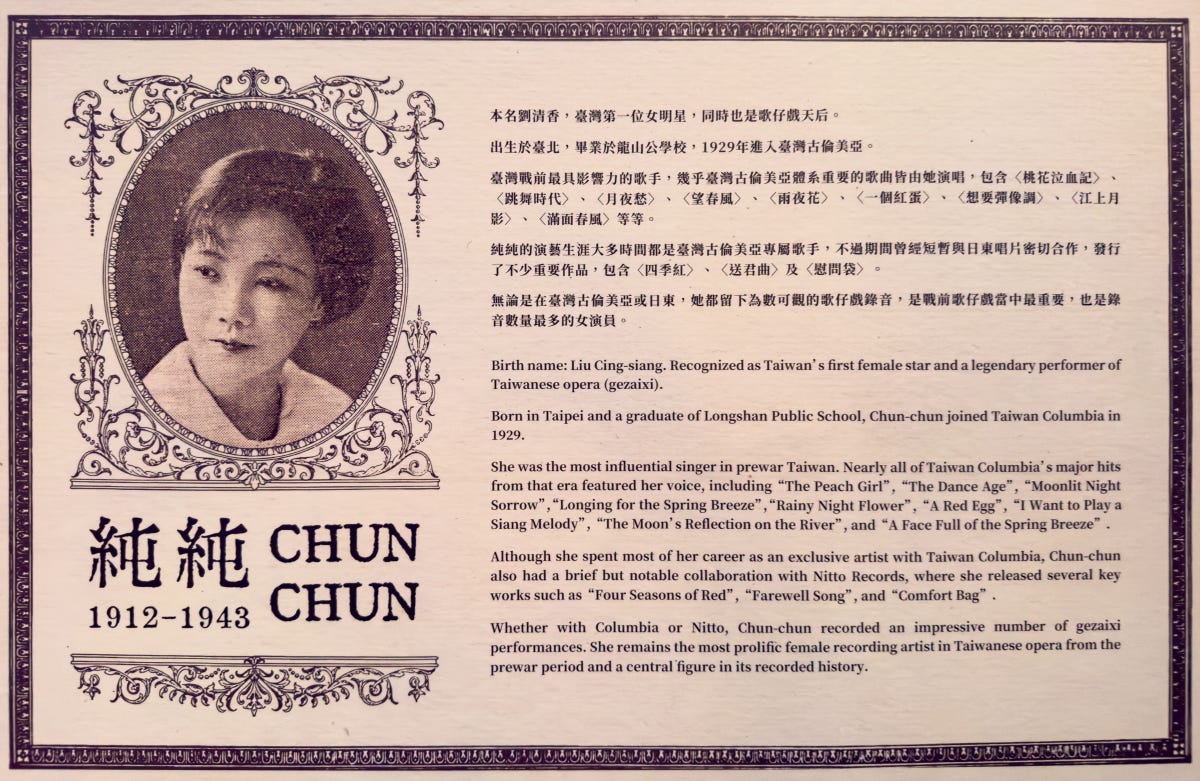
When he first encountered this question several decades ago, Lin Tai-wei realized that he had no answer. Halfway around the globe in Taiwan, he had managed to collect rare, precious recordings of the great stars of Western opera houses in the early 20th century. And yet, at that time he had no knowledge of Sûn-sûn and her contemporaries, the stars who had moved hearts and stirred passions for Taiwanese audiences in the later years of Japanese colonization.
To unearth the most influential Taiwanese of the early 20th century is not simply a question of satisfying historical curiosity. Rather, these are histories that help establish Taiwanese agency over a long period of time, despite repeated waves of colonization. Pace Theodor Adorno, Taiwanese listeners were not simply subjected to whatever schlock the recording companies decided to flood the Taiwanese market with, and which subsequently became familiar. Rather, they celebrated and promoted singers, composers, and lyricists who could speak to their experiences in their own language.
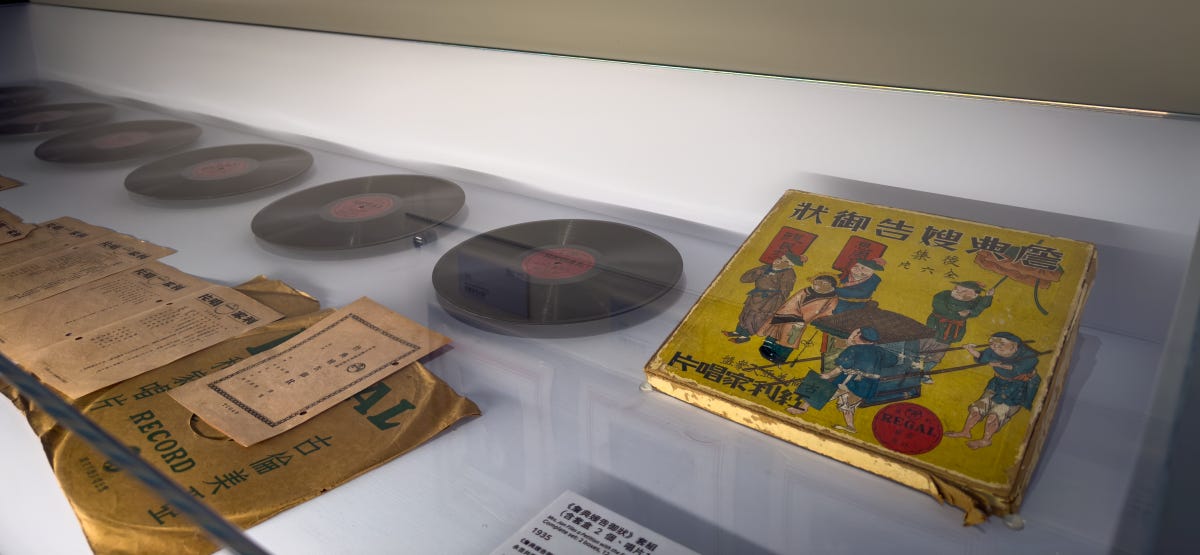
True, recording companies were eager to create a new market for their new technology. Companies like Nipponophone sought out local stars of traditional genres who they could turn into “popular” musicians in the contemporary sense. Early attempts, however, to create local stars were largely unsuccessful. Instead, it took some experimentation before Sûn-sûn burst on the scene as Taiwan’s first local star. Similarly, record labels developed a cohort of lyricists and composers who were reliable hitmakers within the Taiwanese space, and who were particularly attuned to the tastes of Taiwanese listeners.
The remnants of Taiwan’s pre-War popular music industry are not simply relics of fads that have been eclipsed by the tastes of subsequent generations. They are records of a unique local culture that found ways to thrive, even in improbable and hostile circumstances. As such, they provide a pathway around narratives that too often reduce Taiwan to a disputed territory passed back and forth between China and Japan.
The Moral of the Story
At the end of WWII, Taipei suffered heavy bombing from Allied aircraft. The most immediate impact of these actions visited on the Japanese colony was, of course, the loss of life, particularly of civilians. Subsequent disruptions caused by displacement and impairment of public services also caused significant suffering in the immediate aftermath of air raids. These events are addressed directly in the third installment in Hou Hsiao-hsien’s so-called Taiwan Trilogy, The Puppetmaster 戲夢人生.
Some of the damage to the material space of cities like Taipei was repaired over time. For example, in the waning weeks of the war, Allied bombing virtually destroyed sections of the present-day Presidential Office Building in Taipei, formerly the seat of the Japanese colonial government. Following the end of the war, this was rebuilt. Today, the restored building serves as the site of the annual National Day Projection Mapping Show that I have written about previously.
But rebuilding was less possible for artefacts of ephemeral culture like music. Places like the headquarters of Columbia Records were burned to the ground, along with much of their catalog. In the final decades of Japanese rule in Taiwan, hundreds of recordings and thousands of songs were produced, and many of these were lost in the closing weeks of the war.
For recordings and other ephemera that survived the war, subsequent decades took their toll. Shellac discs fracture easily, while heat, humidity, and direct sunlight cause warping and degradation of later vinyl records. Boasting a seismic record ill-suited to stopping delicate objects from toppling off shelves, and a climate that abundantly features sun, heat, and humidity, Taiwan natural conditions provides significant challenges from an archival perspective. (A striking scene in the documentary Viva Tonal shows a collector gently warming a warped LP with a hairdryer in an effort to flatten it and make it playable again.)
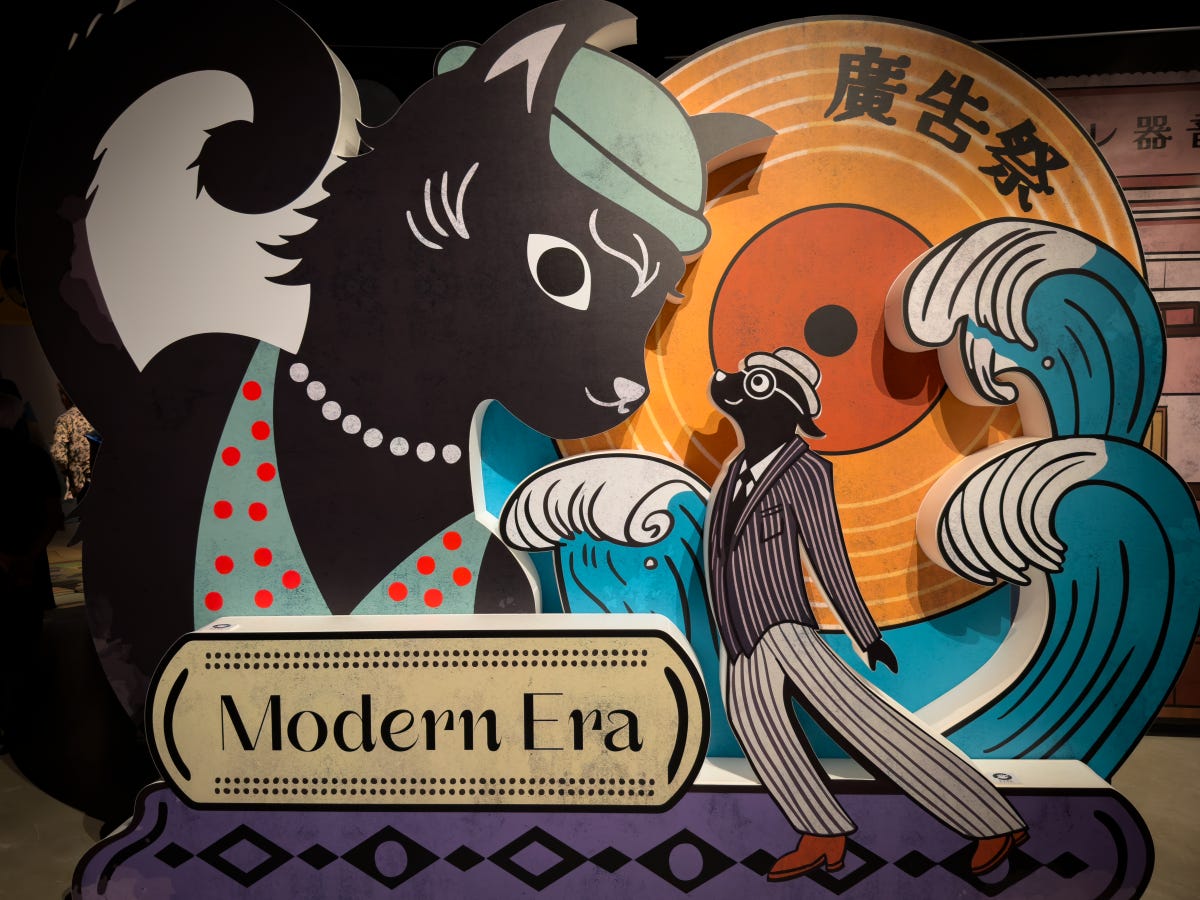
On top of these climate-related archival challenges, we can add decades-long campaigns against both local Taiwanese and Japanese cultural artefacts. Indeed, at various times, both the Japanese and martial law-era KMT regimes worked to suppress Taiwanese-language cultural production. Thus, it should come as no surprise that vintage shops are hardly overflowing with recordings from the era that most interests Lin Tai-wei and the other curators at Modern Era: Dawn of Pop Music. Those recordings and written records that do survive are each miracles in disc-shaped miniature, bearing musical, national, and global histories into the present.
And when these surviving recordings make contact with a spinning plate and a needle, they still make magic.
The Republic of China is the official name used by the government of Taiwan. This is a holdover from the the early 20th century, when the Kuomintang assumed (incomplete) control of the newly founded nation-state of the Republic of China after the fall of the Qing dynasty. Although this name is still in use today in Taiwan, there is wider and wider use of “Taiwan” in outward-facing governmental materials. Most notably, although the Mandarin writing on Taiwanese passports still prominently displays “Republic of China” 中華民國, the Latin script on the passport cover now highlights the word “Taiwan,” while the phrase “Republic of China” has been significantly shrunk.